Photonics Market Growth Declines, However COVID-19 Pandemic May Bring Back Demand in Long Term


As people are becoming increasingly aware regarding the adverse impact that their actions are having on the environment. Therefore, in order to reduce carbon footprints, people are extensively adopting energy efficient solutions, which includes energy efficient lighting solutions. An emerging technology in the field is that of photonics, which is the area of study that involves the usage of radiant energy, and whose fundamental element is photon. 

Photonic applications utilize photon in the same way the electronic applications utilize electrons. Light travels approximately ten times the speed that electricity does, meaning that data transmitted photonically can travel long distances in a fraction of the time. 

As per a report by P&S Intelligence, in 2019, the global photonics market attained a value of $576.8 billion and is predicted to generate a revenue of $1,214.5 billion by 2030, progressing at a 6.9% CAGR during the forecast period (2020–2030). Different product types which make use of the photonics technology are optical component & system, light-emitting diode (LED), sensor & detector, and laser.

Photonics devices further aid in saving energy and are less sensitive to interference and possess unique physical properties. Attributed to these advantages of photonics devices over traditional electronic devices, their demand is predicted to increase significantly in the coming years. 

The demand for LEDs is predicted to advance at a considerable pace in the coming years, which is ascribed to the rapid adoption of the LED technology around the world. Photonics is playing an important role in the development of the LED technology into intelligent digital lighting solutions, which can save 70% of the electrical consumption.


The photonics technology has a number of applications, including display, production technology, information technology, lighting, photovoltaic, measurement & image processing, communication, and medical technology & life science.

Share:

Business impacts of COVID-19 on Urban Air Mobility Market. Strategies of major industry competitors


The traffic on roads is increasing at a rapid pace day-by-day. These days, people are able to afford vehicles easily and the number of public transport vehicles has also risen considerably in the past few years on account of the growing population. Road congestion is a major problem in urban and highly populated cities, and results in wastage of time and also impacts economic growth. Take for instance the situation in the U.S., where people spend about 90 hours in traffic jams each year, on an average. This increases the transportation expenditure of people by more than $1,000. The situation is same, if not much worse, in countries such as China and India.


As per a report by P&S Intelligence, the global urban air mobility market is predicted to reach $895 million by 2023, and it is expected to generated a revenue of $6,889.4 million by 2030, advancing at a 33.9% CAGR during the forecast period (2023–2030). Among passenger and cargo aircraft type, the larger demand in 2023 is projected to be registered for passenger flights. Air taxi, air ambulance, and airport shuttle come under UAM passenger flights. These services are expected to be available for both intercity and intracity commuting. At the present time, aircrafts are being developed for intracity travel due to the strict regulations and limitations in battery technology.

Request for sample copy of this report@ https://bit.ly/3cwEEEr
This being said, the demand for intercity travel is also predicted to rise considerably in the near future, since with technological advancements in battery, motors, and in the fuselage, the range of electric vertical take-off and landing (eVTOL) aircraft will increase as well, thereby allowing people to travel easily from one city to another. Piloted and autonomous are two aircrafts types which are going to be used for UAM. Between these two, the utilization of autonomous aircrafts is projected to be higher in 2030, as they are being considered to be the better suited option for passenger and cargo services.

In the coming years, North America is expected to emerge as the largest urban air mobility market in throughout the time period 2023–2030. This is due to the fact that major cities in the U.S. are registering high traffic congestion, which, in turn, would result in the rapid adoption of airport shuttle and taxi services. Apart from this, the demand for UAM services is also predicted to rise considerably in Europe in the coming years, which is ascribed to the heavy investments in the domain by France and Germany for procuring the eVTOL technology for commercial applications.

In conclusion, the surging road congestion is driving the demand for UAM services. 

Read more: https://www.psmarketresearch.com/market-analysis/urban-air-mobility-market
Share:

How is Growing Adoption of Smartphones Driving Augmented Reality and Virtual Reality Market?

Owing to the rising disposable income of people and technological advancements, the demand and adoption of smartphones has risen considerably in the past few years. At the present time, approximately 3 billion people are using smartphones all across the world. India, the U.S., and China are countries which have the largest number of smartphones users, with each country surpassing 100 million user mark easily. 

Some of the major smartphone vendors across the globe are Huawei, Apple, and Samsung. This is growing penetration of smartphones is further providing platform for other innovative technologies such as virtual reality (VR) and augmented reality (AR). This is because devices such as smartphones and tablets are being hailed as the potential hardware interface for AR and VR technologies and products. 
The AR technology allows the users to experience the real world that has been enhanced or augmented digitally in some way. On the other hand, VR completely removes the user from the real-world experience and replaced it with a world that completely simulated. As per a report by P&S Intelligence, the augmented reality and virtual reality market attained a value of $6.2 billion in 2017, and it is expected to generate a revenue of $94.4 billion by 2023, advancing rapidly at a 58.1% CAGR during the forecast period (2018–2023). 
Between hardware and software components for these technologies, the demand for hardware component was higher in the past. This can be ascribed to the growing requirement for high-performance AR devices, declining cost of products, and rising application areas. 
Between AR devices, including heads up display and head mounted display (HMD), and VR devices, including projection-based device, head mounted display, and gesture control devices, the demand for AR devices is predicted to rise in the years to come. This is because of the fact that AR-based HMDs are gaining traction in different applications including education, automotive, gaming, and military. Moreover, the extensive adoption of mobile AR is expected to drive the demand for AR devices. 
Share:

What are Key Factors Fuelling Surge of Global Automotive Human-Machine Interface Market?

The increasing demand for higher safety features and enhanced user experience in vehicles is one of the major factors pushing the adoption of automotive human–machine interface (HMI) across the world. Since the last few years, there has been a surge in the popularity of various advanced driver assistance systems (ADAS), such as automatic brakes and alert systems, which apprise drivers about the permissible speed limit, traffic situation, and traffic signals, which have, in turn, increased the demand for automative HMI. These HMI systems enhance the interaction between drivers and ADAS systems, thereby leading to better safety of the vehicle and passengers.

Due to the above-mentioned factors, the global automotive human–machine interface (HMI) market is expected to grow from $13.9 billion in 2017 to $29.6 billion by 2023, exhibiting a CAGR of 13.8% during the forecast period (2018–2023). The various types of automotive HMI systems available in the market are steering-mounted controls, touch screen displays, rear-seat entertainment (RSE) consoles, heads-up displays (HUD), instrument clusters, and multi-function switches. Amongst these, HUDs are expected to witness the fastest rise in procurement, owing to the increasing uptake of premium cars.

Request for sample copy of this report@ https://bit.ly/3ct84mN
The automotive HMI market is presently witnessing rapid technological developments, aimed at improving the consumer convenience level. Some of the improvements that have been made in these systems are the development of highly adaptable and dynamic displays and enhanced dashboard layout flexibilities. The soaring government incentives and other measures and increasing adoption of these systems are bolstering the scope for further advancements in them, with each passing year.

Geographically, the highest adoption of automotive HMI systems was observed in the Asia-Pacific (APAC) region in the past few years. This is primarily attributed to the higher sales of passenger cars in this region than anywhere else, on account of the surging purchasing power of the people. Owing to the burgeoning sales of premium and luxury cars and soaring customer preference for vehicles equipped with HMI features in the U.S., North America is expected to witness the fastest growth in the demand for automotive HMI systems during the forecast period.

Therefore, it is clear that due to the increasing adoption of ADAS in vehicles, soaring government initiatives, and growing need for enhanced safety systems in vehicles, the demand for automotive HMI systems will grow considerably in the coming years.

Read More: https://www.psmarketresearch.com/market-analysis/automotive-hmi-market
Share:

How is Growing Adoption of Digital Media Marketing Driving Web Content Management Market?

Ascribed to the surging penetration of internet and strong proliferation of social media platforms, businesses are extensively making use of digital marketing increasing their shares in the global markets. There days, the conventional marketing methods, such as advertising through posters or billboards, are no longer effective, which is why, companies are turning to online platforms, including, mobile application, web applications, websites, search engines, and social media, for ensuring that their products and services come into the limelight. 
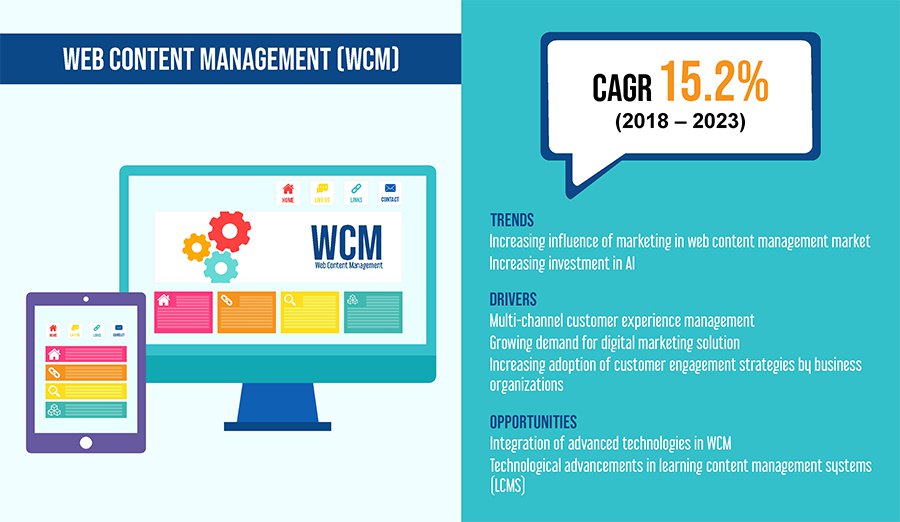
Moreover, enterprises are also taking customer experience management into consideration. All of this is creating a wide need for web content management (WCM) for supplementing digital and multi-channel marketing. WCM basically refers to a program that helps companies maintain, control, change, and reassemble the contents on a webpage. 

The program aids in automating major parts of the publishing process, has the ability of organizing and designing websites for providing effective access to up-to-date and relevant content, and has the ability of preparing and controlling content for publication. 
According to a report by P&S Intelligence, in 2017, the global web content management market attained a value of $4,784.1 million and is expected to generate a revenue of $11,035.4 million by 2023, progressing at a 15.2% CAGR during the forecast period (2018–2023). Both solutions and services are offered under WCM, between which, the demand for WCM solutions was higher in the past. 
This can be ascribed to the growing spending on digital marketing platforms for the promotion of products and related brands and increasing number of internet users in Asia-Pacific (APAC) and European regions. Different WCM solutions are content analytics, digital marketing content management, web creation & editing tools, web experience management, digital asset management, mobile & social media content management. The demand for digital marketing content management was the highest in the past.
Share:

APAC HVAC Market to Witness 4.3% CAGR during 2019–2024


Commercial spaces which use HVAC systems include transportation, hospitality, healthcare, and government establishments, supermarkets/hypermarkets, commercial offices/buildings, data centers, convenience stores, educational institutes, and department stores.

Request Sample Copy of Report : https://www.psmarketresearch.com/market-analysis/apac-hvac-market/report-sample

Apart from the growing demand for HVAC appliances from the commercial sector, the industrial sector, including energy & utilities, oil & gas, automotive, food & beverage, chemical & cement, electronics, and textile plants, is also registering a considerable surge in the requirement for these systems, which can be ascribed to the rapid industrialization in the region.

Since the demand for HVAC systems is booming in the region, advancements such as the development of smart HVAC systems are also taking place. Much like all other smart devices, the major aim of these advanced HVAC systems is to reduce the consumption of energy. Smart HVAC systems provide information regarding their operation and energy consumption.

The users can make use of this information and adjust the system according to their needs, for example the temperature settings, length of preheating or precooling, and times for on and off operations. In addition to this, smart HVAC systems are also embedded with sensors and learning algorithms to learn the user behavior in a better manner.

Within the region, India would witness the fastest APAC HVAC market advance, on account of the Make in India initiative, which is encouraging companies to produce such equipment domestically, thus resulting in a fall in their prices. Additionally, this government initiative is also leading to the growth of the manufacturing sector, in general. With more production facilities being constructed, various types of heating, cooling, and ventilation appliances would be installed.

Hence, the demand for HVAC systems in the region is rising because of the expanding construction industry and adoption of smart HVAC systems.
Share:

Business impacts of COVID-19 on Electric Car Market. Strategies of Major Industry Competitors

Since the Industrial Revolution, the levels of carbon dioxide (CO2), which is the primary greenhouse gas (GHG), have increased threefold, as per the National Geographic Society. This has been a result of the increasing rate of the burning of oil, coal, and other fossil fuels in power plants, vehicle engines, factories, and homes. As per the U.S. Environmental Protection Agency (EPA), the transportation sector is responsible for around 14% of the total GHG emissions around the globe. With alarm bells ringing, steps are being taken to reduce the emission of these harmful substances from automobiles.

As a result of the increasing consciousness and government initiatives, the electric car market is on path to reaching a sale of 5.3 million units in 2025, from merely 0.8 million units in 2016, with this number growing at a healthy 33.6% CAGR between 2017 and 2025. Around the world, countries are launching policies to not only make fossil-fuel-driven automobiles cleaner, but also ultimately replace them with electric vehicles (EV). For instance, apart from the already effective Euro VI emissions norms, certain European countries are targeting a 100% transition to EVs; the Netherlands aims to achieve this by 2030 and the U.K. by 2040.

Request for sample copy of this report@ http://bit.ly/2xl0us4
As per the International Energy Agency (IEA), after rising constantly for two years, CO2 emissions stabilized at around 33 gigatonnes (Gt) in 2019. This was primarily a result of the decrease in the emission of CO2 from the burning of coal in power stations, by around 200 million tonnes (Mt) during 2018–2019. So, while the efforts of the power sector have started being fruitful, the transportation domain has a long way to go. This is why not only European and North American countries, but even Asian nations, especially China, Japan, and India, are framing policies for a switch to 100% clean mobility.

Apart from the concerns for the environment, another reason for the rising sale of electric cars is the decline in the price of the battery, especially lithium-ion (Li-ion) variants. As the battery is the most crucial component of an EV, it decides the purchase price of the entire automobile. As the energy storage devices were quite expensive in the past, they made the EVs costly, which led to their low uptake. But, during 2010–2017, the battery prices dropped by almost 77%, to $227/ kilowatt-hour (kWh), and they are further expected to slump to $110/kWh in the next five years, thus making EVs affordable.

Presently, Asia-Pacific (APAC) is the most lucrative electric car market, on account of the high air pollution levels in regional countries, especially China, Japan, and India. This is why the governments here are offering numerous financial benefits to the customers as well as manufacturers of EVs. For instance, Government of India has invested $1,460 million (INR 10,000 crore) to support the purchase of 1,500,000 electric vehicles by March 2022, under its ambitious Fast Adoption and Manufacturing of (Hybrid &) Electric Vehicles scheme Phase II.

Thus, with governments strongly encouraging the adoption of clean automobiles for the sake of the environment as well as humans, the demand for electric cars will witness a massive rise in the years to come.

Share:

Popular Posts

Blog Archive